Wednesday, 5 September 2018

Recently Digitized Journals Grant Visitors Access to Leonardo da Vinci’s Detailed Engineering Schematics and Musings

Codex Forster II , Leonardo da Vinci, late 15th – early 16th century, Italy. Museum no. Forster MS.141. © Victoria and Albert Museum, London

Codex Forster II , Leonardo da Vinci, late 15th – early 16th century, Italy. Museum no. Forster MS.141. © Victoria and Albert Museum, London

The Victoria and Albert Museum (V&A) in London recently published scans of two of the Leonardo da Vinci notebooks so website visitors can digitally zoom and flip through the drawings and musings of the Italian Renaissance painter, architect, inventor, and sculptor. Jumbled together in the delicate journals are thoughts on both science and art—detailed charts and speculations contained on the same pages as observational sketches of hats or horse hooves.

Da Vinci is believed to have started recording his thoughts in notebooks during the 1480s while he was a military and naval engineer for the Duke of Milan. The writing included in the notebooks was produced in 16th-century Italian “mirror-writing,” which one reads right to left. Scholars have debated the reasoning behind this style, believing it was either a way to code his thoughts, or simply make writing easier as a left-handed artist. “Writing masters at the time would have made demonstrations of mirror-writing, and his letter-shapes are in fact quite ordinary: he used the kind of script that his father, a legal notary, would have used,” an article on the V&A’s website explains. “It is possible to decipher Leonardo’s curious mirror-writing, once the eye has become accustomed to the style.”

The collective title for the five notebooks in the V&A’s collection is the Forster Codices. This digitized set contains his earliest (1487-90, Milan) and latest (1505, Florence) notebooks in the museum’s collection. The name for the journals comes from John Forster who bequeathed the valuable works to the museum in 1876. The V&A plans to digitize the three other notebooks found in the two volumes Codex Forster II and III, for the 500th anniversary of Leonardo’s death in 2019. You can learn more about the series of notebooks in the collection on the V&A’s website. (via Boing Boing)

Codex Forster II (page 10 verso), Leonardo da Vinci, late 15th – early 16th century, Italy. Museum no. Forster MS.141. © Victoria and Albert Museum, London

Codex Forster II (page 10 verso), Leonardo da Vinci, late 15th – early 16th century, Italy. Museum no. Forster MS.141. © Victoria and Albert Museum, London

Codex Forster II (page 123 verso), Leonardo da Vinci, late 15th – early 16th century, Italy. Museum no. MSL/1876/Forster/141/II. © Victoria and Albert Museum, London

Codex Forster II (page 123 verso), Leonardo da Vinci, late 15th – early 16th century, Italy. Museum no. MSL/1876/Forster/141/II. © Victoria and Albert Museum, London

Codex Forster III (page 23 recto), Leonardo da Vinci, late 15th – early 16th century, Italy. Museum no. MSL/1876/Forster/141/III. © Victoria and Albert Museum, London

Codex Forster III (page 23 recto), Leonardo da Vinci, late 15th – early 16th century, Italy. Museum no. MSL/1876/Forster/141/III. © Victoria and Albert Museum, London

Codex Forster II (page 75 recto), Leonardo da Vinci, late 15th – early 16th century, Italy. Museum no. Forster MS.141. © Victoria and Albert Museum, London

Codex Forster II (page 75 recto), Leonardo da Vinci, late 15th – early 16th century, Italy. Museum no. Forster MS.141. © Victoria and Albert Museum, London

Codex Forster II (page 91 verso), Leonardo da Vinci, late 15th – early 16th century, Italy. Museum no. MSL/1876/Forster/141/II. © Victoria and Albert Museum, London

Codex Forster II (page 91 verso), Leonardo da Vinci, late 15th – early 16th century, Italy. Museum no. MSL/1876/Forster/141/II. © Victoria and Albert Museum, London

Codex Forster III (page 9 recto), Leonardo da Vinci, late 15th – early 16th century, Italy. Museum no. Forster MS.141. © Victoria and Albert Museum, London

Codex Forster III (page 9 recto), Leonardo da Vinci, late 15th – early 16th century, Italy. Museum no. Forster MS.141. © Victoria and Albert Museum, London

The Three Volumes of Codex Forster, Leonardo da Vinci, late 15th – early 16th century, Italy. Museum no. MSL/1876/Forster/141. © Victoria and Albert Museum, London

The Three Volumes of Codex Forster, Leonardo da Vinci, late 15th – early 16th century, Italy. Museum no. MSL/1876/Forster/141. © Victoria and Albert Museum, London

Tuesday, 4 September 2018

365 Days of Miniature Cut Paper Egrets, Sparrows, Pelicans and Other Birds

Ruby Throated Hummingbird

India-based cut paper artists Nayan Shrimali and Vaishali Chudasama have set out to construct 365 miniature bird species by the end of 2018. To form each work, the pair begins by cutting feathers, beaks, and talons from layers of paper and then using watercolor to produce further detail. Despite the works’ small size (some of the tiniest pieces measuring only 3/4 of an inch from head to tail), each bird takes four to six hours to finish depending on the extent of the bird’s colorful plumage. You can stay updated with the artists’ miniature project on Instagram, and buy tiny avian artworks by the duo on their Etsy Shop.

Snowy Egret

Snowy Egret

Raven

Raven

Baya Weaver Bird

Baya Weaver Bird

Bali Myna

Bali Myna

Indian Peafowl

Indian Peafowl

Brown Pelican

Brown Pelican

House Sparrow

House Sparrow

Griffon Vulture

Griffon Vulture

Darter

Darter

Sliced Footwear Arranged in Uncanny Configurations by Sakir Gokcebag

Turkish-born visual artist Sakir Gokcebag (previously) deconstructs everyday objects, often eradicating their original functionality in order to form humorous installations. His works are created from items one might find around the house such as hula hoops, brooms, toilet paper rolls, and pairs of worn shoes. The later series of altered footwear spans more than 15 years, and has been installed in surreal arrangements both inside and out of the gallery.

For these pieces Gokcebag chops the front toe off of neutral-toned work boots and other sturdy footwear. He then arranges the pieces in circles, rows, and parallel lines that split elevated platforms. The installations appear digitally composed, and playing a trick on the viewer as they attempt to decode the visual manipulation. Gokcebag has lived and worked in Hamburg, Germany since 2001. You can see more of his oddly arranged objects, like this belt that has been sliced and folded to appear like a ribbon, on his Instagram.


Indoor Installation of 10,000 Plants Considers Relationship Between Endangered Australian Grasslands and Architecture

All images by Rory Gardiner

For Australia’s Venice Architecture Biennale pavilion, curators Mauro Baracco and Louise Wright, of Baracco+Wright Architects worked with artist Linda Tegg to create Grasslands Repair, a 10,000-plant recreation of the grasslands of southeast Victoria. The living indoor installation spans much of the pavilion and extends to its outdoor space, with walkways that allow viewers to move among the 65 species of Western Plains Grasslands plants.

The theme for the 2018 biennale (which opened in May) is “Repair,” which was described in a press release as a way of considering how architecture can “play a role in repairing the places it is part of.” Only one percent of the grasslands of mid-18th century Victoria still exists— largely the result of urbanization and industrial land use — so for Baracco, Wright, and Tegg, Grasslands Repair shows the real cost of human land occupation. “The area of plants exhibited is similar to that taken up by the pavilion,” the curators said. “It is also a smaller area than that of an average Australian family house. Such an area takes around an hour to bulldoze.”

Supporting the living garden from above is an installation called Skylight, which uses LEDs as an artificial light source since the walls and ceiling of the structure block the sun. Throughout the biennale, films that explore the theme of Repair are screened on the walls of the Grasslands Repair installation, including Ground, which was created by Baracco+Wright and Tegg in collaboration with David Fox. Without the history of the region for context, the installation is just another indoor garden perfectly suited for selfies, but with the knowledge of what human interaction has done to indigenous species, it becomes a call to action to try and undo the damage we have done.

The 2018 Venice Architecture Biennale continues through November 25, 2018. (via Dezeen)

The Kids from the Victor School Returns from Guatemala. Here’s the Recap!

the whole group from Victor School
Earlier this year, we announced our latest FLYTE partnership, with the Victor School from rural Montana. Our goal was to send a group of its high school students to Guatemala for a week and a half of learning, service, and travel.

Quick side note: If you’re new to this website, FLYTE (Foundation for Learning and Youth Travel Education) is the nonprofit foundation we created just over 3 years ago to send high school classes on educational and service trips overseas. Our mission at FLYTE is to empower students through transformative travel experiences.

We know the power of travel to change you – and so do the teachers we partner with. That’s where FLYTE comes in. We serve underserved communities around the United States that don’t have the resources to send their kids abroad. So far we have sent classes to Mexico, Ecuador, and Cuba.

And with your help, we did it again. We raised over $18,000 to help these students go on their school trip to Guatemala.

The students, the school, the parents, me — we all thank you for being part of this!

In late June, they landed back in Montana, so today I wanted to give you an update on their trip so you know where your help went. (I know, I know. It took a while for this update to happen. I’m a slow writer.)

The school is located in the small rural town of Victor, Montana that serves a total student population of 300 where 100% of the students receive free or reduced-price school lunch. The poverty rate is high in this community and many families struggle to make ends meet.

After three flights and nearly 20 hours of travel, the kids made it to Guatemala. For most, this was their first time leaving the United States, visiting a developing country, being in a place where the culture and language are starkly different than that of their hometown, and for some, it was their first time out of Montana!

FLYTE trips are not just vacations for teens. The itineraries are crafted to include various forms of learning, teaching, adventures, interacting with local communities, and activities that push themselves out of their comfort zones.

The students spent the first part of their trip in the city of Antigua, where they took Spanish lessons and climbed the Pacaya volcano. That adventurous experience impacted the students and what they thought they were capable of so much that they stopped on their way down and took out their journals to document their exhilaration and acknowledge themselves.

students posing in Antigua

On the shores of Lake Atitlán, they experienced living communally. Part of their service learning took place at the Amigos de Santa Cruz local NGO, where they made authentic Mayan cuisine, learned about vocational training programs, and donated books they collected in Montana for the NGO’s preschool library. They spent the afternoon playing soccer and hacky sack with the other neighborhood kids. (Most of the kids said this was their favorite

Additionally, they spend time volunteering with Konojel, a nonprofit whose mission is to reduce chronic malnutrition and endemic poverty. They helped out at the community center where undernourished children receive healthy meals and educational enrichment. Victor School students working with Konojel

The trip to Guatemala ultimately changed their perceptions about the world outside the United States (and small-town Montana!) — and what they wanted to create with their own life.

As the students reflected on their trip, we heard a few common themes:

The first was the realization that what they heard on the news is not always actually accurate. And they really understand now how powerful and important it is to see and experience things for yourself to build your own understanding. It’s a sad reality that we see on the news is not the whole picture and “if it bleeds, it leads. Just check out what the students had to say about their shift in how they viewed Guatemala once they experienced it first-hand:

“I wasn’t going to go to Guatemala because of all the stuff I heard others saying about it, like that I would be kidnapped, or that it was poor, or that I would get lost. But I’m very happy I did, because that wasn’t true at all,” said Zoe. “I’ve never had people smile at me randomly, but these people in Guatemala did.”

Or as Sam R. said, “A lot of [my] family said Guatemala was a dangerous place and gave it a bad reputation without ever being there, but when I went, everyone was super friendly and I was comfortable.”

And even though these students come from an economically-deprived, more rural part of the United States, traveling overseas made many of them realize how lucky they have it compared to others. This is one of the key things I realized when I went on my first trip overseas. It’s what got me out of my head and made me realize that I had a lot more opportunities that I thought when I was living back at home.

Sam thought that “(being from a family with no money) I had nothing, yet there are places with even less than us. It makes me more grateful for all of the little things we have, like hot water.”

Ellyse couldn’t believe that “little things to us — like school and clean water and toilet paper — are such a privilege and we abuse it” after seeing how rare those were on the trip. “I thought Victor needed a lot of work and that it was rural, but it’s not [that] bad.” Most of the students came back from Guatemala much more grateful teens with new perspectives on how many opportunities they have, rather than what they don’t have.

working with children in Guatemala

This was also echoed by Sophie, who said, “We realized how much we take for granted, like toilet paper, clean water, and free education.” For Emma, “it made me more grateful for what we have, like good water, garbage/recycling services, etc. I am so lucky to live where I do and I am so grateful for all I have.”

Sam wants to work harder in school “because I now know what kind of opportunity I have.”

Summer observed, “We are so spoiled. We have so much more than some people in Guatemala could even dream of.” Sam S. said, “that although Victor is considered poor by American standards, we still have it very easy.” Madison felt that she had “a personal experience of how the real world works, how different countries are truly so different. It made me appreciate my home so much more.”

The students had other epiphanies as well. Gracie realized that “everyone has their own way of living, and mine is no better than anyone else’s.” Emma said, “It’s easy to forget that there’s so much outside of your little bubble and bigger issues in the world that we don’t see or experience in the U.S.”

Many realized they could push themselves beyond their comfort zone and do things that they never thought they could do.

Sadie “tried many different foods and tried to enjoy things that would normally scare me,” and Emma said “I achieved my goals by putting myself really out of my comfort zone. I learned that even in rough times, I can do what I need to make myself feel better.” Gracie really liked the shared hostels (two thumbs up from me!) even though she had never experienced anything like that before.

students posing in Antigua

This trip inspired them to travel more too!

Zoe wants to go to Hawaii and also possibly back to Guatemala (“and bring my family with me so they can see it’s not dangerous, just adventurous”). Ellyse would like to go to Sydney, Haiti, Nicaragua, and Mexico. Summer also wants to visit Australia. Julia wants to study abroad in Spain. Audrey wants to go to Greece, Norway, France, Spain, “and so many more countries.” Sam would love to go to Guatemala again to see other areas. Madison has been inspired to travel “everywhere!”

Sophie plans on traveling, and this trip “helped teach me not to have any presumptions about a place I’m going and to just allow myself to learn there.”

These lessons that the students learned are why I created FLYTE — and why it’s so great that so many of you support the mission too.

With the division, lack of understanding, and fear of “the other” that’s permeating our culture today, this is exactly what makes it all worth it. The fundraising, coordinating group travel logistics, and the challenges of running a nonprofit — worth it. These students left their comfort zones and had experiences that created a shift in their perspective.

Will this single trip of Guatemala change the world? Maybe, maybe not. But what it does is put these kids on a path toward success, toward growth, and toward thinking bigger! And we never know the ripple effect that occurs once we’ve thrown that first single pebble. By cracking open the door, we allow other things to get through that will only widen it with time.

Thank you again for helping us raise money for the school and making an impact on these teens!

students posing in Antigua

***
Three final thoughts:

First, we’ve already started the search for our 2019 partner school. If you or someone you know is an educator in an under-resourced school and wants to have an experience like the Victor School’s, we’d love for you to apply.

Second, just as it takes a village to raise a child, it took an entire community to send these students to Guatemala. Thank you to all our partners for making it possible for students to experience new cultures and countries and to broaden their worldviews! We are forever grateful to these sponsors:

  • World Nomads, our travel insurance provider, which donated coverage for all our students and chaperones. A very big thank you to them for helping out and ensuring our students were protected!
  • MYGHT Travel, which managed all our airline bookings and donated eye masks so the students could get some shut-eye on their flights.
  • Om the Go, which donated Asana pillows for the entire group. The kids practiced yoga daily and loved that they all had their own personal yoga mats to stretch out and sweat on.
  • Our team of FLYTE Champion blogger fundraisers, who created their own fundraising pages and helped us fund this trip: Carol (Wayfaring Views), Kristen (Kids Are a Trip), Gabi (Dream of Travel Writing), Anisa (Two Traveling Texans), Nicole (Wandering with a Dromomaniac), Amelia (Passports from the Heart), and Maggie (The World Was Here First).
  • Path’s Crossing, a travel card game that prompted questions that made the group both laugh hysterically and cry with gratitude. The company donated a game to Victor School and a percentage of all its sales to FLYTE.
  • Mahadevi Ashram, which housed the group at Lake Atitlán and provided them with daily yoga and meditation at a discounted rate.

Lastly, infinite thanks to our individual donors. We know that there are many worthy organizations out there, and we’re honored that you chose to donate to FLYTE. You made this trip happen and we can’t thank you enough!

The post The Kids from the Victor School Returns from Guatemala. Here’s the Recap! appeared first on Nomadic Matt's Travel Site.

Saturday, 1 September 2018

The Best Things to Do and See in Brussels

https://www.flickr.com/photos/mathayjl/28779189690/
Updated: 9/1/2018 | September 1st, 2018

Welcome to the capital of Belgium and the European Union. At times it can feel a little stuffy, but it is also a picturesque and historic city with lots to offer to intrepid traveler. The city has plenty to keep you busy (especially if you’re a fan of beer!) and makes for a great stop over between nearby Amsterdam and Paris.

There have been people in the Brussels area since the Stone Age. Its location enabled it to benefit from trade, growing rapidly under Roman and then Frankish rule. The city was almost destroyed by the French during the Nine Years Wat in 1695 when over 4,000 buildings were destroyed. The region was then controlled by the Netherlands until 1830 when the Belgians declared independence.

There is a lot of things to see and do in Brussels. I think the city is worth a good two or three-day visit in order to soak in all the history, food, and beer!

Things to Do and See in Brussels

Here is a video of my favorite attractions in the city:

Don’t want to watch the video? Fine! Here’s a list of everything you should see:

  • The Royal Palace – This palace was originally constructed in the 18th century. It’s where the King and Queen host receptions and handle state affairs, though they don’t actually live there full time. To help you get a sense of the size, the facade of the building is actually 50% longer than Buckingham Palace!
  • Notre Dame – This 15th-century Gothic Catholic church, officially titled The Church of Our Blessed Lady of the Sablon, was where the city’s rich and well-off came to worship. The church is also home to two incredible Baroque chapels that were added in the 17th century.
  • The Palace of Justice – The most important court in Belgium, the Palace of Justice was built in the 19th century and was actually the largest structure built in that century. This massive building is actually larger than St. Peter’s Basilica in Rome and cost approximately 45 million Belgian Francs to construct and furnish.
  • Manneken Pis and Jeanneke Pis – These are two famous statues in the city. One is a replica from the 17th century while one is a more modern addition. What makes them interesting (and a bit odd) is that they are of children peeing. They are meant to reflect the Belgian sense of humor, which is why they are hugely popular in the city.
  • Petit Sablon – This park has a collection of 48 statues, each representing a historical profession that was common in the city. Every pillar and statue has a unique design, as does each section of the wrought-iron fence. The central fountain is surrounded by a semicircle of 10 famous individuals from the 16th century.
  • European Parliament – Book a tour and get a glimpse behind the scenes of the unofficial capital of Europe. These informative tours will give you a much more nuanced understanding of how the EU works and how it goes about making changes that affect all of its member states.
  • Galeries Royales Saint-Hubert – This is the oldest shopping arcade in Europe, home to cafés, restaurants, and chocolate shops. It was designed as a way to create a shopping area that was well lit, to prevent illicit and nefarious goings-on (essentially it was made so the rich could feel more comfortable going there).
  • Cantillion Brewery – This brewery was founded in 1900 and now offers tours to the public. On the tour, you’ll get to watch the beer-making process in action, learn about older brewing equipment and methods from the 20th century, and sample some of their beer!
  • Drink at Delirium – This place has the longest beer menu in the world, home to over 2000 beers (they actually won the Guinness Record for it!). There are beers from over 60 countries here, including a wide selection of Belgian beers. Sure, it’s crowded and touristy, but it’s fun and a great place to try the local beers.

Budget Travel Tips for Visiting Brussels

To make the most your of your visit, here are a few tips to help you enjoy your time in Brussels:

  • Brussels is a tiny city and incredibly walkable. Save money on public transportation and just walk everywhere!
  • The area near the Palace of Justice as well as the Place Jordan is great for dining and drinking.
  • Skip the Beer Museum as it’s not worth the money. Instead, head to the brewery in the video for a more engaging experience.
  • If you’re flying into Brussels Charleroi Airport (the budget airport), be sure to book your ride to town in advance. FlixBus is the cheapest option, with tickets for as little as 5 EUR. BlaBlaCar is another budget-friendly option, as well. The regular shuttle from the airport will be around 14 EUR.
  • Get the plat du jour. Many restaurants offer a dish of the day or a fixed menu at cheaper prices during lunch, which will save you a few bucks if you plan on eating out.
  • Rent the Villo. These bikes are available around the city for free if you are traveling for less than half an hour. If you need it for more time, a day pass is 1.60 EUR and a 7-day pass is 8.20 EUR.
  • If you’re going to use public transportation, get a metro pass. A single journey on the metro system is 2.50 EUR but the day pass is 7.50 EUR. If you’re staying longer in the city, buy a MOBIB basic card for 5 EUR. It will save you almost 1 EUR per trip!
  • Skip renting a car. Unless there is a specific reason or you’re going to be driving out into the countryside, you don’t need a car. Traffic can be slugging, and the trains and buses are perfectly fine for getting around.
***

Whether you’re here for a weekend getaway or planning to stick around for a few days (or weeks!), Brussels will be able to keep you entertained. It’s a picturesque city with all the beer, waffles, chocolate, and frites that you can handle, making it a worthwhile stop on any trip to Europe.

Book Your Trip to Brussels: Logistical Tips and Tricks

Book Your Flight
Find a cheap flight to Brussels by using Skyscanner or Momondo. They are my two favorite search engines. Start with Momondo.

Book Your Accommodation
My favorite hostel in Brussels is Sleep Well. You can book a different hostel in Brussels with Hostelworld. If you want to stay elsewhere, use Booking.com as they consistently return the cheapest rates. (Here’s the proof.)

Don’t Forget Travel Insurance
Travel insurance will protect you against illness, injury, theft, and cancellations. I never ever go on a trip without it. I’ve been using World Nomads for ten years. You should too.

Need Some Gear?
Check out our resource page for the best companies to use!

Want More Information on Brussels?
Be sure to visit our robust destination guide on Brussels for even more planning tips!

The post The Best Things to Do and See in Brussels appeared first on Nomadic Matt's Travel Site.

Waitomo’s Glow Worm Caves

Glow worms Waitomo
Updated: 9/1/2018 | September 1st, 2018

Waitomo is famous for one thing: worms. And not just any ol’ worms but glow worms! Every year thousands of travelers come here to see the famous glow worms that line the ceilings of the nearby caves.

The interesting thing about the glow worms is that they aren’t really worms at all. They’re actually fly larvae that emit a phosphorescent glow that shines from the inside of the caves like a starry night, lighting up the ceiling. So, why do they glow if they’re not glow worms? Well, it’s actually their waste and snot that glows. The larvae developed this glow to attract prey into their sticky threads by making the prey believe they’re outdoors. Since the cave ceiling looks like a starry night, the prey will try to fly upwards and end up stuck in the larvae strands. The hungry larvae will then devour their prey.

While glowing fly larvae may not sound like an amazing activity, as you can see from the photos it’s still incredibly captivating and beautiful.

The caves were discovered in the late 19th century by a local Maori chief. They were opened to the public shortly thereafter, with local Maori acting as guides. While the caves were taken over by the government for many years, they were eventually returned to the Maori. In fact, many of the present-day workers are descendants of the original founders of the caves. The Ruakuri cave, in particular, has significant links to the spiritual traditions of the Maori.

These days, over half a million people visit the caves every year. A huge industry has built up to help people visit the Waitomo glow worm caves, with plenty of options available depending on what you’re looking to do. There’s the three-hour black-water tubing trip, the five-hour trip that includes abseiling and climbing, or if you like it easy, a boat through a bigger cave.

Glow worms Waitomo

My Glow Worm Experience at Waitomo Caves

Waking up early in the morning, my group headed out to the cold waters of Ruakuri cave. We wetsuited up and practiced jumping into the inner tubes we would ride through the caves. I wasn’t happy that I had to jump off not one, but two small waterfalls. Worse yet, this had to be done backward so I could land in my tube. The waterfalls are only a meter or two high, but I really hate heights. Yet at that moment, realizing a wetsuit doesn’t keep you dry but simply wet, I found something I hated even more.

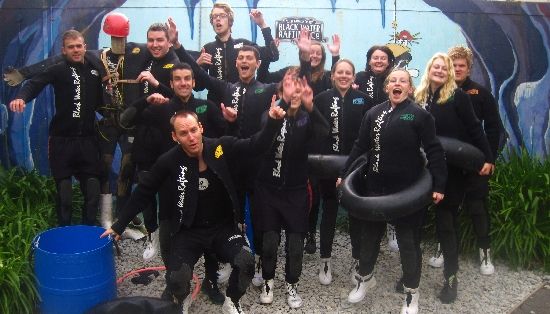
After our practice jump, we, a crowd of 12 wet-suit-wearing, boot-wearing, helmet-wearing backpackers, marched gingerly towards our destination. After a short walk in the woods, we entered the glow worms’ dominion and were given a quick tutorial about how the next few hours would go. Sadly, it felt like the tutorial lasted longer than the trip—away from the light, surrounded by darkness and the rushing chill of the water, the hours seemed to pass by in minutes. Just as I was adjusting to the experience, the end of the tunnel came and we were topside again.

12 wet-suit wearing people executed to see glow worms

But the experience in between was amazing. After our instructions, we began to descend into the cave. We walked through tight openings and tunnels and waded through quick-moving and very cold water. Sometimes the water was ankle deep, other times chest height. Eventually, we came to the first milestone: waterfall #1. I met the waterfall with trepidation. My group, knowing my fear, encouraged me to go first, but that wasn’t going to happen. I went third. My fear was that I’d never jump far enough to clear the rocks. I didn’t jump far enough. As my tube landed in the water, my foot lightly touched the bottom rock.

From there, it’s an easy cruise through the cave, where above you, you begin to see glow worms like stars in the sky. They seemed limitless in number. It reminded me of my childhood when I used to put those glow-in-the-dark cosmos stickers on my ceiling and stare at them as they lit up my room.

But the day’s biggest challenge lay ahead: waterfall #2. This waterfall was much higher than the first, and to me, it might as well have been Niagara Falls. I had to make everyone count twice before I was ready to jump. Closing my eyes, I jumped, and this time I jumped far enough. But I hated every minute of it. I still prefer to have my feet on the ground.

Yet from here until the end it was smooth sailing…or tubing in this case. The rest of the way was all glow worms. Leaning back in my tube, I floated down the river, marveling at the beauty of the light show and the tranquility of my surroundings. But the tunnel’s end came too quickly, and I was left wanting to go back and stare upwards just a bit longer.

Glow worms Waitomo

I can see why the glow worm caves are one of New Zealand’s biggest tourist attractions. They’re beautiful. The caves are peaceful. Overall, it’s an amazing experience. Three hours seemed too short, but five hours might have been a bit too long. I’d go back to see the glow worms again, and, whether you abseil, tube, or simply cruise in a boat, the glow worms are not to be missed.

How to Visit the Waitomo Glow Worm Caves

Waitomo is 200km south of Auckland. By car, it’s around a two and a half hour drive, while by bus it’s closer to 3 hours. Expect to pay around 35 NZD for a one-way bus ticket from Auckland. A bus from Rotorua will cost around 35 NZD each way.

Once you get to Waitomo, here are some suggested companies to visit the glowworm caves with:

Prices will vary depending on the company and time of year but, generally, water tubing is 145 NZD per person, tubing and abseiling is 250 NZD per person, and a simple boat ride is 51 NZD per person.

While the glowworm caves in Waitamo are not a cheap activity, they are definitely one you should make an effort to do. You won’t regret it!

Book Your Trip to Waitomo: Logistical Tips and Tricks

Book Your Flight
Find a cheap flight to Waitomo by using Skyscanner or Momondo. They are my two favorite search engines. Start with Momondo.

Book Your Accommodation
You can book your hostel in Waitomo with Hostelworld. If you want to stay elsewhere, use Booking.com as they consistently return the cheapest rates. (Here’s the proof.)

Don’t Forget Travel Insurance
Travel insurance will protect you against illness, injury, theft, and cancellations. I never ever go on a trip without it. I’ve been using World Nomads for ten years. You should too.

Need Some Gear?
Check out our resource page for the best companies to use!

Want More Information on Waitomo?
Be sure to visit our robust destination guide on Washington, D.C. for even more planning tips!

Photo credits: 1, 2, 4

The post Waitomo’s Glow Worm Caves appeared first on Nomadic Matt's Travel Site.