Tuesday, 29 May 2018

The Magnetic Force of Urs Fischer’s Life-Size Metallic Rhinoceros

URS FISCHER, "Things" (2017), Milled aluminum, steel, power magnets, two-component epoxy adhesive, 125 1/4 x 204 3/8 x 118 1/2 inches (318 x 519 x 301 cm), Edition 1 of 3 & 1 AP, © Urs Fischer. Photo: Robert McKeever. Courtesy of the artist and Gagosian.

URS FISCHER, “Things” (2017), Milled aluminum, steel, power magnets, two-component epoxy adhesive, 125 1/4 x 204 3/8 x 118 1/2 inches (318 x 519 x 301 cm), Edition 1 of 3 & 1 AP, © Urs Fischer. Photo: Robert McKeever. Courtesy of the artist and Gagosian.

Things stands poised as the singular sculpture in a new installation by Swiss artist Urs Fischer, yet like its title might suggest, the lone work is composed of several disparate parts. At the piece’s core stands a life-size aluminum copy of a rhinoceros with a magnetic presence that has attracted several man-made objects into its grand orbit. A vacuum cleaner, step stool, toilet, car door, and frying pan all cling to its wrinkled metallic skin.

The work questions one’s attraction to and use of everyday objects, considering how and what we accumulate as we move through our individualized worlds. “‘Art’ has always been a word for this thing that can’t be rationalized, when you see or hear something that you struggle to explain,” says Fischer in a press release about Things. “But that’s its strength, of course.”

The massive aluminum work is on view at a disused bank at 511 Fifth Avenue in midtown Manhattan through June 23, 2018. This installation coincides with Fischer’s exhibition of new paintings titled Sōtatsu, which also runs through June 23 at Gagosian Gallery's 980 Madison Avenue location. (via The New York Times)

URS FISCHER, "Things" (2017), Milled aluminum, steel, power magnets, two-component epoxy adhesive, 125 1/4 x 204 3/8 x 118 1/2 inches (318 x 519 x 301 cm), Edition 1 of 3 & 1 AP, © Urs Fischer. Photo: Stefan Altenburger. Courtesy of the artist and Gagosian.

URS FISCHER, “Things” (2017), Milled aluminum, steel, power magnets, two-component epoxy adhesive, 125 1/4 x 204 3/8 x 118 1/2 inches (318 x 519 x 301 cm), Edition 1 of 3 & 1 AP, © Urs Fischer. Photo: Stefan Altenburger. Courtesy of the artist and Gagosian.


How to Overcome Your Travel Fears

How to overcome your fears
Fear. It’s what often keeps us from living our lives and achieving our dreams.

And it is one of the most common reasons why people don’t travel.

Whenever I talk to people about long-term travel, so many tell me they wish they could do what I do. They tell me all their travel dreams and grand plans then when asked why they don’t pursue them, they come up with a plethora of excuses:

They fear not being able to afford the trip.
They fear they have too many responsibilities at home.
They fear they won’t be able to make friends on the road.
They fear not having the ability to handle it.
They fear something will happen to them.

With all that fear, it’s much easier to stay at home in our comfort zones than to break out and travel.

It’s a big thing to step out your door, away from your safety net, and into the known.

You may want to but the devil you know is always better than the devil you don’t.

Yes, travel is a privilege and there are real money issues that keep people at home.

But one of the most common emails I get is from people asking about “the mental issues” of travel. “The mindset stuff.” Do they quit their job and go for it? Are they in the right stage of life? Will everything be OK if they leave? Will they get a job when they return?

These emails are peppered with nervous excitement over travel’s endless possibilities, but there is also always one underlying tone to the emails: “Matt, I want to go, but I’m also afraid and I’m not sure what to do.”

While many people claim “real world responsibilities” are the reason for not traveling, I think fear of the unknown is really what holds people back the majority of people back. When you get rid of your fears and decide “Yes, I’m going to do this!”, you begin to find ways to scrape, save, find work, and do whatever it is that gets you on the road.

You become a person on a mission. You become driven. Nothing will get in your way.

But first, you need to get over any fear you might have. I was on a podcast recently discussing this subject and so it has come to the forefront of my mind again. Here is my advice on dealing with fear:

You aren’t the first person to travel abroad.
One of the things that comforted me when I began traveling was knowing that lots of other people traveled the world before me and ended up just fine. If some 18-year-old from England on a gap year came home in one piece, there was no reason I wouldn’t too. You aren’t the first person to leave home and explore the jungles of Asia. Columbus and Magellan had a reason to be afraid. You don’t.

There is a well-worn tourist trail out there. There are people to help you. There are people to travel with. You aren’t going to be alone.

And you aren’t venturing into the true unknown.

You made it this far.
If you already have one foot out the door, why turn back now? What will you regret later in life: that you let your fears keep you home, or that you went traveling? Sometimes you just have to go for it. Everything works out in the end. Don’t turn back halfway. You can do this!

You are just as capable as everyone else.
I’m smart, I’m capable, and I have common sense. If other people can travel the world, why can’t I? What makes me think I lack the skills? I realized that there was no reason I couldn’t do what these other people did. I was just as good as everyone else.

Don’t doubt yourself. You got by in your life just fine now. The same will be true when you travel. Moreover, now has never been an easier time to travel thanks to all the resources available online and all the sharing economy websites that help connect you with other travelers.
Facing your travel fears

Responsibilities can vanish in a flash.
Everyone uses “responsibility” as the main reason to avoid travel. But that is just your fear telling you that you have things at home that can’t be let go of. However, those responsibilities are simply chains that hold you down. When I quit my job, I didn’t have to work anymore. When I canceled my bills, they disappeared. When I sold my car, the payments were gone. When I sold my stuff, I didn’t have any. We think this is all very complicated, but with a few phone calls, everything that held me back was gone, taken care of. Suddenly, my responsibilities disappeared. Vaporized. It is easier to cut the cord than you think.

You will find a job when you get home.
Another reason people get held back is the belief that when they go overseas, they will become unemployable. They worry that employers will see a gap in their résumé and not want to hire them. But in this globalized world, having experience with foreign cultures and people is a real asset. So is showing that you are independent, courageous, and capable. After all, no one makes it around the world without learning these skills. Employers realize this and now look at travel as a positive thing that teaches intangible personal skills no business school ever could.

Related articles:

You will make friends.
People always ask me how I make friends on the road. They tell me that they’re not very social and that it’s hard for them to meet strangers. The truth is that when you travel, you are never alone. There are many solo travelers out there in the same boat as you. You’ll find people who will come up and talk to you, even if you are too scared to go up to them. I used to be nervous talking to strangers, but the fear subsides as you eventually realize that everyone wants to make new friends. And one of those friends is you.

Related Articles:

You can always come back.
If you make it three months into your trip and decide that long-term travel isn’t for you, it’s perfectly OK to go home. There’s no shame in cutting your trip short. Maybe traveling isn’t for you, but you would never have known if you didn’t try. There’s no such thing as failure in the world of travel. Travel teaches us many things including, that sometimes, we don’t like to travel. Getting up and going is more than most people do, and if it isn’t for you, at least you tried. That in itself is a major accomplishment.

***

Fear is an element that affects everything we do. Yes, fear is a healthy biological response designed to make sure we don’t do foolish things. But, in many ways, fear is the reason why we never succeed. It’s scary leaving everything you know and heading off into the unknown. However, once you look at why you are afraid of doing it, you’ll realize there’s no reason to be. You can travel. You are capable. It’s not as hard as you think.

Don’t let fear win.

Note: This article was originally published in 2011 but redone and updated with new tips and links in 2018.

The post How to Overcome Your Travel Fears appeared first on Nomadic Matt's Travel Site.

Monday, 28 May 2018

How Much Does it Cost to Travel Western Europe?

the cost of traveling western europe
Europe is not a monolithic place, and prices vary greatly depending on how far north, east, south or west your travel. Europe covers a huge area of the world with multiple visa zones and multiple currencies. For 20 euros, you can get a private room in Greece. For that same price in Paris, you may get a 16 person dorm room. You can eat for a few euros in Spain or Hungary, but a sit-down meal in Italy will cost around 15 euros, and triple that in Norway!

I’ve been going to Europe for close to ten years now. Europe isn’t cheap, but there are plenty of ways to cut down costs. Since Europe is so big, today I want to talk about traveling around Western Europe and the Eurozone countries.

How much do things cost?

Here are some general costs for things in Europe, because as I said, prices can vary a lot depending on where you are:

  • Accommodation: In most Western European countries, expect to pay 25–35 euros per night for a dorm room. (Though in Greece and Spain, it’s only 10–20 euros per night.) In Scandinavia, expect to pay around 30–35 Euros per night. In England, prices are usually around 20–30 pounds per night.
  • Food: Food costs vary as wildly as accommodation costs. Cheap fast food meals cost 9–15 euros, while restaurants meals cost around 15–25 euros. Nicer establishments will cost 30 euros or more. You can cook your food for a week for around 65 euros>.
  • Transportation: The easiest way to get around Europe is by train. Trains connect every major part of Europe, and they’re often very cheap. High-speed trains, though, can cost over 100 euros. Try to get the regional or slow trains for cheaper prices! The rise of cheap airlines like Ryanair, EasyJet, and Transavia has made flying around Europe in a hurry really cheap. For flights, expect to pay around 50 euros if you book in advance. Transportation around most cities is only 1–2 euros.
  • Activities: Most museums and tours start at around 14 euros. It’s cheaper, of course, in eastern Europe. Full-day tours cost 35–100 euros. Prices vary drastically per country, so it’s hard to give a good general cost of this budget item.

How to Save Money in Western Europe

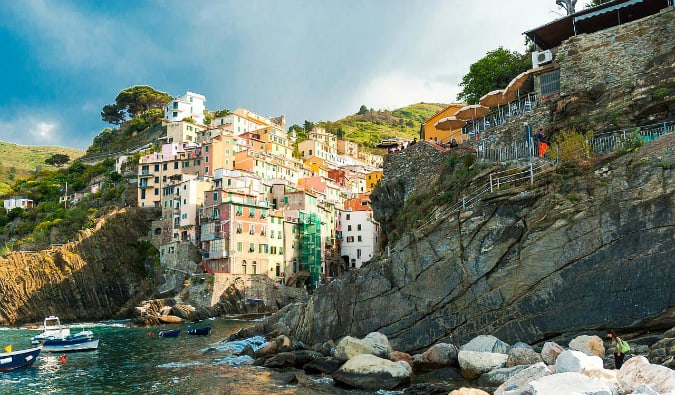
Beautiful view of the Western European homes in Cinque Terre, Italy=

  • Picnic – Europe has a lot of tiny shops where you can be premade sandwiches or ingredients to make your own. Buy some food, eat outside, and watch the city go by. It’s a cheaper and more enjoyable way to eat.
  • Eat Local and Cheap – Not into picnicking? That’s OK, there are other ways to save money on food. Eat at local sandwich shops, pizza parlors, Maoz, Wok to Walks, outdoor street vendors, and the like. Avoiding restaurants and eating at a lot of the local “grab ‘n go” places will give you a taste of the local cuisine at a much cheaper price.
  • Couchsurf – Hostels can add up really quick in Europe. If you don’t have any friends you can stay with, consider using the service Couchsurfing, which lets you connect with locals who will let you stay with them for free.
  • Fly Cheap – If you know where you’re going and a train won’t do, try to book flights early. You can often get one-euro fares from many of the discount airlines like Transavia, Easyjet, Air Berlin, and Ryanair. MORE: There are many cheap ways to get across Europe.
  • Drink Less – Those five-euro beers really add up. Hit happy hour or pick and choose when you party. Hostel bars are a good place to get cheap drinks, or you can buy your alcohol at the supermarket. Partying your way across the continent will destroy your bank balance in no time.
  • Take the Free Tours – One of the great things about Europe is that you can find free walking tours in all the major cities. They can be a great way to see the city attractions, learn some history, and get your bearings without spending any money. Almost every city in Europe has a free walking tour available. Your hostel or the tourism board will have details!
  • Camp in a garden – A very good camping service specific is Campspace (formerly Camp in My Garden), which allows you to pitch a tent in someone’s backyard for free or a nominal fee (around 4-10 EUR). This is a new service that started in 2010 but more and more people are signing up for it each day. All of the garden owners have profiles that tell you what services and facilities they offer.
  • Get a Rail Pass – Eurail Passes have saved me hundreds of dollars when I used them. If you are traveling far distances and through many countries, they are a great deal. Here’s more information how to pick a Eurail pass.
  • Get a city tourist card – Local tourism offices issue a tourist card for all their attractions, tours, and restaurants. This card gives you free entry and substantial discounts on all the attractions and tours in a city, free local public transportation (a huge plus), and discounts at a few restaurants and shopping malls. They save a ton of money. If you plan on doing a lot of sightseeing, get one of these cards.
  • Rideshare – Hugely popular and widespread in Europe, I did this to get around Switzerland, France, and UK. BlaBlaCar, the biggest website, connects drivers and riders and lets you get around much cheaper than a bus or train. Moreover, this way is amazing for getting off the highways, seeing more the countryside, and meeting locals. It’s money-saving and much more exciting than taking the train or bus!

What’s a good daily budget in Europe?

the cost of traveling western europe
Recently, I went through Amsterdam, Greece, Italy, and Hungary. In 59 days of traveling, I spent 4,317 euros, which averages out to 73.17 euros per day. That includes a few flights, many a nice meal, too many drinks on Ios, a few nights of private rooms (it was my birthday, after all!), and some unexpected purchases (a jacket, a new iPhone charger, and new headphones).

On a backpacker budget, if you were avoiding flights, occasionally Couchsurfing, staying in cheap dorms, and cooking most of your meals, you could average between 40-50 Eur per day. It would be a tight budget but you could definitely do it. One of the biggest costs in Europe is accommodation so reducing that cost will help a lot!

However, if you wanted some flexibility in your schedule, planned to eat out only stay in hostels, and visit a lot of places, plan for around 70 euros a day.

If you’re going to stay in only private rooms or Airbnb as well as eat at sit down restaurants every meal, I’d say budget closer to 100 euros to be safe.

***

Western Europe costs a lot. It’s never going to be a cheap area of the world to travel but with some smart money management and follow the tips in this post, Western Europe can become at least an affordable place to visit. Control your costs and you can be able to see anything!

Are you planning on traveling to Europe? Check out my guides for Iceland, Paris, Stockholm, and Amsterdam! For more information, you can also visit my page on backpacking Europe.

Book Your Trip to Western Europe: Logistical Tips and Tricks

Book Your Flight
Find a cheap flight to Western Europe by using Skyscanner or Momondo. They are my two favorite search engines. Start with Momondo.

Book Your Accommodation
You can book your hostel in Western Europe with Hostelworld. If you want to stay elsewhere, use Booking.com as they consistently return the cheapest rates. (Here’s the proof.)

Don’t Forget Travel Insurance
Travel insurance will protect you against illness, injury, theft, and cancellations. I never ever go on a trip without it. I’ve been using World Nomads for ten years. You should too.

Need Some Gear?
Check out our resource page for the best companies to use!

Want More Information on Europe?
Be sure to visit our robust destination guide on Europe for even more planning tips!

 
Originally posted in 2010. Updated to reflect 2018 prices and changes.

The post How Much Does it Cost to Travel Western Europe? appeared first on Nomadic Matt's Travel Site.

Friday, 25 May 2018

Hand-Dyed Crocheted Thread Carefully Nestles Eggs, Seeds, and Tree Trunks

Esther Traugot connects to the natural world by collecting and covering seed pods, eggs, severed tree trunks, and other natural objects in tightly-wrapped textile “skins.” She uses hand-dyed gold threads to crochet around these objects in order to temporarily mend what has previously been broken or abandoned. Through her work Traugot straddles the line of nurture and control, investigating her dual role as a member and observer of the natural landscape.

“The meticulous act of crocheting mimics the instinct to nurture and protect what is viable, what is becoming precious,” she explains in an artist statement. “As in gilding, these false ‘skins’ imbue the objects with an assumed desirability or value; the wrapping becomes an act of veneration. Although futile in its attempt at archiving and preservation, it suggests optimism.”

Traugot is interested in “contemporary naturalism,” or artwork that cares for the environment in our current global ecological state, and also views her work in conversation with Land and Environmental Art and Feminism. She received her BFA from the University of California Berkeley in 2005 and her MFA from Mills College in 2009. Traugot is represented by Chandra Cerrito Contemporary Gallery in Oakland, California, and currently lives and works in Sebastopol, CA. You can view more of her gold threaded objects on her website.

Macro Infrared Photographs Unlock the Depth of Green in a Stunning Array of Canary Island Plants

All images via Field

Marcus Wendt, creative director at the London-based studio Field, recently traveled to the island of Lanzarote to shoot a series of macro images of the region’s native plants. His project, Suprachromacy transforms cacti and other light-absorbing species into vibrant, multi-hued beings through infrared photography. Needles and spines of one species glow bright blue, while others are illuminated in deep orange tones.

The project was inspired by Isaac Newton’s quote, “For the Rays, to speak properly, are not colored. In them, there is nothing else than a certain power and disposition to stir up a sensation of this or that color.” Its intension is to spark inquiry about a color’s origin. Is color an inherent part of the object? Or is it an individualized sensation?

“For us, these alien color spectra spark ideas about how we see color, how much depth is locked up in the color green, and whether color is a property or a sensation,” says Wendt. “And also what plants might look like on planets under a different colored sun.”

You can see other technology and photo-based projects by Field on their website and Instagram. (via My Modern Met)

Thursday, 24 May 2018

We’re 75% of the way to completing this mission! Help us get to 100%!

Students from Victor
Dear fabulous reader,

I was in the shower (where I do some of my best thinking), pondering all the political fighting and social media outrage that seems to happen every week. Well, ok every day!!

Each day, people yell into the echo chamber.

I don’t know about you, but I have slight “outrage fatigue.” I can’t get up in arms anymore about a single speech or tweet, or what someone is wearing. I’m tired of it, and real problems don’t get solved that way.

They get solved by getting out there and doing something.

I recently read a great book called The Death of Expertise, which talks about how study after study has shown that people online tend to wall themselves off from opinions they don’t agree with because it’s easier than ever to just find information that confirms what you already believe.

But as travelers, we meet people from around the world. We experience cultures and values different than our own. I think is why travelers tend to be more open-minded than most. We have a broader perspective. We’ve been outsiders ourselves. We travel because we want to see the differences in the world, not hide from them.

Which is why, thinking about this topic, I am glad we have FLYTE, our community charity that raises money to send high school students on international trips to help expand their minds and put their education into practice. FLYTE aims to show kids that the world is much bigger — and full of more possibility — than they could ever imagine!

So far we’ve raised $26,000 to send these kids on a volunteering trip to Guatemala:

Students from Victor

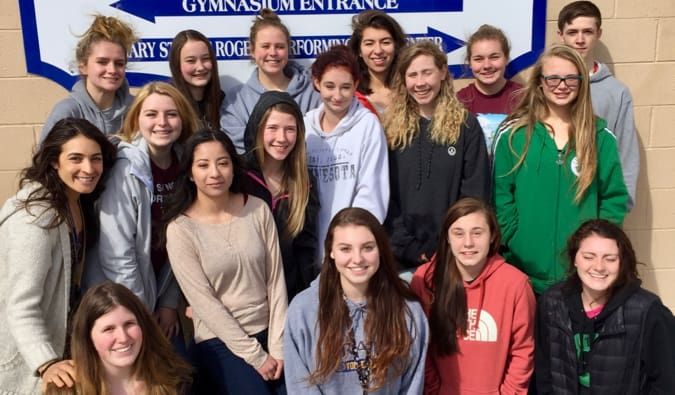
These are the students from the Victor School in Victor, Montana, a small town of only 800 in rural Montana that is 96% white. Living so far outside a metropolitan area makes it hard for them to interact with a diverse range of people. Ten days in Guatemala isn’t a lot of time for us, but for these kids, it represents the start of a bigger, more important journey.

But we need another $7,000 more to make this trip happen!

And I’m asking for your help to help us get us to the finish line! On bended knee!

This trip is their chance to get out (even if only for a moment) and see the world, experience new cultures, and see the possibilities that exist beyond their small town. It’s a chance to spark an interest in the world and in education.

It is a chance to turn these kids — who, thanks to FLYTE, now have passports — into travelers and global citizens.

It is a chance for them put their schooling into practice.

It is a chance for them to see a world completely different than their own and develop empathy. To broaden their horizons and not just listen to what cable news or a curated social feed tells them.

It’s never been more important to broaden people’s perspective.

And it starts with these kids.

Because they will soon be the adults of the future.

For as little as $1, you can help us get there. If everyone who reads this website gave a dollar, we could make this – and many more like it – happen right away!

We can be the change we want to see in the world. Travel has done so much for us. So many people have been strangers in unknown lands.

If you’ve been wondering how you can pay it forward and get involved in building a better world, this is your chance.

I know this is a budget travel website and most of us don’t have a lot of money but for the cost of a few drinks, you can pay it forward and help great a new generation of responsible travelers!

These kids, their teachers, and their parents will be forever changed by your generosity.

If you’re the type of person that believes love trumps hate, help us help these kids.

If you’re the kind of person that is looking for a way to spread the power of travel, help us help these kids.

Let’s pay all our travel kindness forward and send these kids from the small town of Victor to Guatemala!

Thank you so much for any support!

Sincerely,

Nomadic Matt

P.S. – Please help us share this organization and cause by forwarding this blog post to your friends and family or sharing it on social media! Let’s change some lives!

The post We’re 75% of the way to completing this mission! Help us get to 100%! appeared first on Nomadic Matt's Travel Site.

Interior Bas-Relief Sculptures of Peacocks and Lush Florals by Goga Tandashvili

Russian artist Goga Tandashvili carves large-scale bas-relief works in interior spaces, adding details such as florals, tropical leaves, and perched peacocks to otherwise flat surfaces. The three-dimensional murals project from the wall with a life-like accuracy, with each bloom and sprout of plumage having the same shape and size as the object it imitates. Tandashvili uses a combination of hand building and carving techniques to create the nature-based sculptures, which act as fluid extensions of the wall itself. (via My Modern Met)