
Artist Bennett Ewing travels the world collecting pieces of wood from mountains, deserts, beaches, and forests to form expressive sculptural portraits. Using the natural shapes and tones of his found wooden materials, Ewing, who goes by the artist name Eyevan Tumbleweed, builds evocative facial features and wild hairstyles. The artist states, “the sylvan entities and their expressions of thought and emotion portray a glimpse of an otherworldly realm that is not altogether unfamiliar.” You can see more of Ewing’s artwork on his website and Instagram. (via Supersonic Art)
Wednesday, 27 June 2018


A 38-Foot-Tall Whale Made From 10,000 Pounds of Plastic Waste Surfaces in Bruges

In response to the Bruges Triennial's 2018 theme “Liquid City,” Brooklyn-based architecture and design firm STUDIOKCA designed a 38-foot-tall sculptural whale composed of over five tons of plastic pulled from the Pacific and Atlantic oceans. The studio, led by Jason Klimoski and Lesley Chang, wanted to address how cities from across the globe are contributing to the waste that has piled up in our oceans—the discarded plastic that is washing up on our shores and endangering and killing marine life.
Skyscraper contains nearly 4,000-square-feet of plastic waste, which is just a dent in the 150 million tons of plastic that currently circulates in our seas. STUDIOKCA worked with the Hawaii Wildlife Fund to coordinate several beach clean-ups, which is how the team found most of the plastic for the 10,000-pound whale.
“Right now there is 150 million tons of plastic swimming in the ocean, our oceans, the oceans we share,” says Klimoski in a video created about the project. “Pound for pound that is more plastic waste swimming in the ocean than there is whales. So an opportunity like this to show the type of plastic and the amount of plastic that ends up in our oceans is really important.”
You can learn more about the team’s process behind the large-scale whale on their website and in the video below. The Bruges Triennial continues through September 16, 2018. (via Colossal Submissions)


Triënnale 2018; STUDIOKCA – ‘Skyscraper (the Bruges Whale)’

Triënnale 2018; STUDIOKCA – ‘Skyscraper (the Bruges Whale)’


Triënnale 2018; STUDIOKCA – ‘Skyscraper (the Bruges Whale)’

Tuesday, 26 June 2018
New Black and White Laser-Cut Animations by Matthias Brown Imitate 19th-Century Optical Illusions

Graphic designer Matthias Brown (previously here and here) creates hand drawn animations and cut paper GIFs which he posts to his Tumblr, Traceloops. Previously he’s experimented with rotoscoping techniques for his looping works, which requires each element of the animation to be scanned or traced, frame-by-frame. His subject matter is typically figural, working with dancing bodies, disembodied hands, or melting faces.
Recently, Brown has revisited paper-based animation with a centuries old method called a phenakistoscope. His handmade sculptures are laser-cut from one piece of paper, and imitate the mid-19th-century device by animating as they spin. Brown’s animation above was created from one of these devices, with a full version of the work on Vimeo. You can view a larger range of his recent GIFs on Traceloops.


7 Cheap Ways to Travel Across Europe

Updated: 6/26/18 | June 26th, 2018
Traveling around Europe can be fairly expensive. Airline tickets, high-speed trains, overnight trains, ferries – they can all eat into your limited and precious travel budget. I mean you came to spend money on delicious food and wine, not transportation!
However, there are a few recent trends that have helped travelers get around Europe cheaper: weaker currency exchange rates, the rise of the sharing economy, new bus options, and lots of new budget airlines.
The 7 Best Ways To Travel Europe Cheap
Travelling Europe by Megabus

Megabus is a cheap way to get around the United Kingdom (England, Scotland, Wales) as well as to Paris, Brussels, and Amsterdam. Tickets can cost as little as 1 GBP if you book at least a month in advance on popular routes to get these fares. However, even if you don’t scoop up these amazingly cheap deals, you can still travel for a more reasonable price than on the national bus system, as fares rarely top 20 GBP. I recently took a 5 GBP bus from London to Bristol. (The train? 45 GBP!) That ticket was only bought the day before too! Additionally, Megabus also operates trains to some destinations around the UK, starting at 10 GBP. Megabus is definitely the cheapest way to get around the UK and now is also the cheapest way to get to Paris, Brussels, or Amsterdam.
Travelling Europe by Busabout

Busabout is a hop-on/hop-off bus service primarily used by backpackers, similar to the Oz or Kiwi Experience in Australia and New Zealand, respectively. You can get on and off whenever you want along one of their set routes. You can buy tickets that let you travel their whole network with a set number of stops. For example, a nine-day flex-pass, which gives you nine stops from your starting city. The only downside to Busabout is that if you want to visit a city not on their route, you have to make your own way there at an added cost. A lot of backpackers use this method of travel to get around as well as meet other travelers. The pass also comes with a guide and sometimes include group activities. A two-week pass is $299 USD. If you figure you can visit about 6 cities in two weeks, that’s $50 a trip. When you consider the soft benefits of a guide, included trips, and meeting people, Busabout becomes price comparable to trains and flights, though still more expensive than a regular public bus! Their unlimited passes for $1,499 for 6 months of travel is the best long-term transportation deal.
Travelling Europe by Flixbus
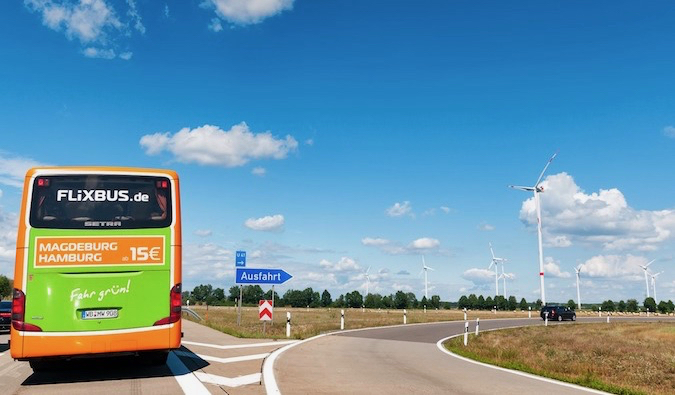
Over the last few years, a new company has come on the market that has totally changed the bus system in Europe! German based Flixbus has routes in 20 European countries and thousands of cities with prices starting as low 5 EUR. Their buses include WiFi, electrical outlets, up to three 3 free bags, and comfy seats. It’s essentially Megabus, but less sucky and for the whole of continental Europe. Flixbus quickly became my favorite non-train way to get across Europe cheaper after it came out. It’s the best and cheapest way to get around continental Europe!
Another option is to take Eurolines. Every country in Europe has its own national bus service but for international long distance bus routes, they sort of combine into the umbrella company, Eurolines. While they serve more destinations than Flixbus, I prefer the comfort and prices of Flxibus if I have a choice between the two. Eurolines prices usually start at around 20 Euros for a 5-6 hour journey.
Travelling Europe by Budget Airline

By far one of the cheapest ways to travel long distance in Europe is by budget airline. These airlines are hugely prolific on the continent and competition leads to incredibly cheap fares. You can often find fares as cheap as 1 Euro. When I need to go somewhere and I don’t want to take a long bus or train journey, I fly budget airlines. My favorite budget airlines are:
I use Skyscanner and Momondo to search for the best deals. They do all the legwork for ya!
It’s important to remember that these budget airlines make most of their money through fees, and the second you mess up, they whack you with a fee. They are very strict about baggage limits or forgetting to print out your boarding pass. Be sure to follow their rules to the letter. Sometimes these budget airlines cost more money because of all their fees so if you’re traveling with a lot of bags, it may be cheaper to fly with one of the larger airlines (which have also lowered their fares in the face of tough competition).
For more information, here is a complete guide to finding cheap flights around Europe.
Travelling Europe With A Eurail Pass
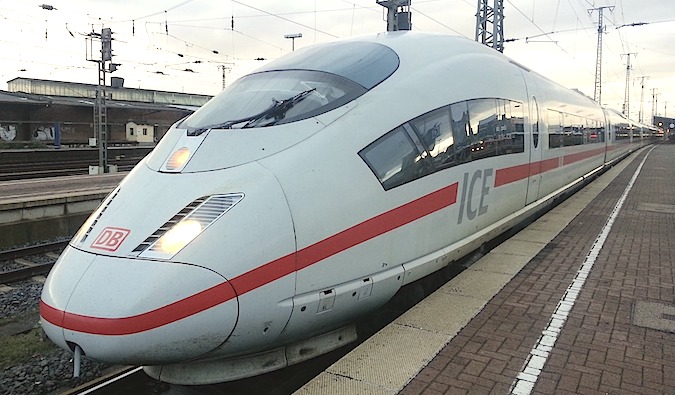
Getting a rail pass is a good option if you are going to be traveling across vast distances and don’t want to fly. The European rail system is one of the best and most extensive in the world. I love traveling by train. Sitting in a big seat, relaxing with a book, and watching the stunning landscape go by. It’s more comfortable than a bus and much less stressful than air travel.
If you’re going to travel by train, it’s hard to beat them on price and convenience for short city to city travel. For longer journeys (overnight journeys, between countries, or rides that require a high-speed line like Paris to Bordeaux or Berlin to Munich), trains tend to be very expensive. If you plan to travel around Europe in a grand tour, a rail pass is your best money saving travel option. Your cost per trip will be a lot lower than if you were to buy these tickets separately.
For more information, here is a complete breakdown of Eurail passes and when they should be used to save money.
Travelling Europe Using BlaBlaCar

The rise of the sharing economy has allowed people to hop a ride with locals going their way, and BlaBlaCar is the reigning king of this service. Hugely popular and widespread in Europe, I’ve used this service many times. This website lets you rideshare with people who have extra space in their car. You find a ride, they agree to take you, and off you go. You can find rides for as little as 5 Euros. It is the best, BEST paid way to get around Europe. You get to meet a local, have a friendly conversation, save tons of money over bus and train travel, and get off the highways and more the countryside.
Alternatively, there are websites where you can ask for rides so long as you pitch in for gas. Gumtree is the most popular among backpackers.
The Cheapest Way To Travel Europe: Hitchhiking

The best way to travel Europe cheap is to not pay for it. Hitching is quite common in Europe, and I’ve met a number of travelers who have done it. I myself traveled this way in Bulgaria. It’s important to use your head when hitchhiking.
There are a lot of ways to get around Europe on a budget. But what’s the best way for your trip? MIX AND MATCH YOUR TRANSPORTATION. The key to traveling around Europe on the cheap is to know when to use each one of the listed transportation methods. For short trips, I like trains and BlaBlaCar. For medium length trips (half a day), I’ll take a bus, BlaBlaBla car, or train. For long distances, I fly, take a high-speed train, or overnight buses. If you have no preference on how you travel – you just want the cheapest – use a website like Rome2Rio. All you have to do is enter where you are going and they will find all the ways to get there and list the prices for each method.
When you are looking for cheap ways to travel Europe, use the transportation options above that suit your needs and you’ll always get the best deal!
Next step: keep planning your trip to Europe with these articles:
- Continent-Wide Europe Travel Guide
- The Cost of Western Europe Travel
- The Cost of Traveling Eastern Europe
- Is a Eurail Pass Worth the Cost?
The post 7 Cheap Ways to Travel Across Europe appeared first on Nomadic Matt's Travel Site.
Meticulous Acrylic Paintings by Shawn Huckins Erase Historic Works from the White House Art Collection

“My Button Is Bigger Than Your Button” (Marquis De Lafayette, White House Art Collection Erasure No. 7)
At first glance, Colorado-based artist Shawn Huckins’ “Erasure” series looks like a collection of images that have been altered using a digital eraser tool to reveal the empty checkered pattern layer beneath. A closer look reveals that the works are actually meticulously detailed acrylic paintings, recreations selected from the White House Art Collection. Superimposed on the works are hand-painted erasure marks that serve as a commentary on the ideas of history, legacy, and whether or not those things can be wiped away in the present.
While the patterned marks range from measured and uniform to seemingly haphazard flourishes, for Huckins the resulting “obliteration” of history is the same. “The underlying works chosen for this series originally served as testaments of those who came before us and the indelible mark they left on the world, in a very short time, not so long ago,” the artist said in a statement. “In an era where the internet makes everyone a publisher, and digital editing tools bestow the power to create realities out of pixels, The Erasures forces us to examine our assumptions regarding the longevity of individual influence and institutions, thus raising enormous questions concerning the fragility of legacy.”
Huckins shares with Colossal that the collection of paintings are his “response to the current US administration’s policies and ethics surrounding a divisive country.” In his statement he poses several questions to the viewer about one person’s ability to “erase the impact of another,” whether or not longstanding ideals are more easily erased than recent progress, and how the events of today will be “recorded, judged and preserved when anyone can create, or re-create, his or her own reality with a keystroke, or a mouse-swipe, or a dead-of-night tweet?”
Shawn Huckins will debut 18 paintings from the Erasure series as a part of an upcoming solo exhibition titled Fool’s Gold, which opens at Modernism Gallery’s new space in San Francisco on July 11, 2018.

“Nothing Rhymes With Orange” (George Washington, White House Art Collection Erasure No. 5)

“If Only I Could Remember Your Name” (Mary Elizabeth Woodbury, White House Art Collection Erasure No. 8)

“The Most Beautiful Place Is Far From Here” (Rocky Mountain Scene, White House Art Collection Erasure No. 16)

“Loneliness Of Leaker” (John Adams, White House Art Collection Erasure No. 20)

“He Said. She Said. She Said.” (Julia Gardiner Tyler, White House Art Collection Erasure No. 18)

“Tell It Like It Was” (First Lady Caroline Harrison, White House Art Collection Erasure No. 3)

“Planet B” (Pastoral Landscape, White House Art Collection Erasure No. 6)

“Me, Myself, And Hypocrisy” (George Washington, White House Art Collection Erasure No. 13)
Monday, 25 June 2018
Tommie Smith’s Iconic Protest Salute Immortalized in Gold by Glenn Kaino

Starting in 2013, Los Angeles-based conceptual artist Glenn Kaino has had the opportunity to meet and collaborate with a man whose act of protest had long inspired him. “Bridge” is Kaino’s 100-foot long construction featuring two hundred casts of former American track and field runner and Olympic gold medalist Tommie Smith’s arm, which he raised as a human rights salute during the National Anthem after taking gold at the 1968 Summer Olympics. Kaino’s work will be installed as a part of a larger exhibition at the High Museum in Atlanta in fall 2018. We spoke with the artist to learn more about how his collaboration with Smith came to be.
On the podium of the 1968 Summer Olympics in Mexico, African American medalists Tommie Smith and Juan Carlos went from being top-performing athletes representing the United States to legendary activists with a simple yet powerful gesture. The photograph of Smith and Carlos with their heads lowered and their leather-clad fists raised is one of the most iconic images of the 20th century, and Kaino tells Colossal that it is one that he used to have taped to the side of his iMac.
A friend of Kaino’s noticed the picture and referred to Tommie as “Coach Smith,” revealing that he knew the former athlete from his days as track coach. The friend set up the meeting, and Kaino soon found himself at Coach Smith’s home in Atlanta, watching tape of the race in slow motion as Tommie broke it down almost frame by frame. “I didn’t have a pitch,” Kaino said of the way he finally approached the topic of collaboration with the gold medalist and his wife, “but I did have an observation.” He noticed that Tommie Smith’s home was like a “time bubble,” with memorabilia and references to his career and to his most famous moment. Kaino says that as someone who was born after the salute, the image has always been symbolic, but for the Smiths it was personal. “You shook my hand with that arm, you brush your teeth with that arm,” he said to Tommie.
Through the conversation, Kaino convinced Tommie to collaborate on a project that would remove the icon (the arm) from his body and help him see the salute the way that others do. Back in Los Angeles, after experimenting with what Kaino believes to have been the arm of an Aquaman figure, they got to work casting Smith’s arm and clenched fist. He used the cast to create hundreds of fiberglass arms, which he then painted gold and hung from wires to form, according to the artist’s website, “a golden path leading forward from the present but connected to the past, a spectacular reconciliation of a historic record, an individual memory, and a public symbol all renegotiated in an infrastructure of time to creates stories of the now.”
As for connecting the past and present, it is interesting to consider Kaino’s work and Smith’s salute as it relates to Black athletes today, like Colin Kaepernick, who are criticized for publicly protesting similar issues 40 years later. Kaino tells Colossal that he is working on a documentary to tell Smith’s story that goes deeper than the one image that everyone knows. For those who want to see “Bridge” in person, the exhibition titled With Drawn Arms: Glenn Kaino and Tommie Smith opens in Atlanta, Georgia at the High Museum on September 29, 2018. (via Artnet)


Studio Drift’s Solo Exhibition ‘Coded Nature’ Floats a Concrete Monolith Above Museum Visitors

Photo: Gert Jan van Rooij. Meadow (2017), choreographed in 2018. Aluminum, stainless steel, printed fabric, LEDs, robotics. Collection Studio Drift, Amsterdam, courtesy collection DELA, Eindhoven.
One of the must-see shows in Amsterdam this summer is the debut museum solo of Studio Drift (previously) at Stedelijk Museum, which balances elements of tech art, performance, and biodesign. The exhibition, titled Coded Nature, presents a wide range of transdisciplinary works from the Dutch studio that engage with topics from sustainability to issues raised by the growing use of augmented reality.
Founded by Lonneke Gordijn and Ralph Nauta, Studio Design typically creates installation, sculptural works, video projections, and interactive VR. One of the standout pieces in their new exhibition is Drifter, a floating concrete monolith measuring 13 x 6 1/2 feet, which tenderly levitates inside one of the museum galleries (the video below shows the work on display earlier this year at the Armory Show in New York). The puzzling effect of seeing such a familiar object floating through space is emphasized with a video projection of the film Drifters, which follows the same concrete sculpture as it floats through the Scottish Highlands.
Contrasting the effect of the large floating concrete block is the breathtaking installation Fragile Future Chandelier 3.5 which consists of countless bionic dandelions with glowing LED lights at their centers. The labor-intensive installation, like many of the studio’s works, challenges relationships between man, nature, and technology. Other works include the light installations Tree of Ténéré and Flylight, and kinetic installations Semblance and In 20 Steps, which are all based on naturally designed forms or movements.
Studio Drift: Coded Nature will run through August 26, 2018. You can see more site-specific installations and science fiction-inspired works on the studio’s website and Instagram, and take a deeper look inside the duo’s process in the video below.

Photo: Sasha Bogojev for Colossal

Photo: Gert Jan van Rooij. Flylight (2009). Glass, custom made fittings, LEDs, algorithm, electronics, sensors. Courtesy Carpenters Workshop Gallery, London.

Photo: Gert Jan van Rooij. Gazm and Studio Drift, branch of Tree of Ténéré (prototype 2017). Steel, hand modeled epoxy, paint, rubber, LEDs, electronics. Collection GAZM, courtesy Pace Gallery, New York.

Fragile Future Chandelier 3.5 (2012), manufactured under the control of Carpenters Workshop Gallery. Collection Stedelijk Museum Amsterdam.

Fragile Future detail modules. Courtesy of Carpenters Workshop Gallery.

Ghost Collection

Photo: Tom Cornelissen. Drifter (2018), Stedelijk Museum Amsterdam. Courtesy of Pace Gallery.
Subscribe to:
Posts (Atom)